📁 The files are yours
No hidden database. Your whole family history is plain text files and your own photos in one folder. The app decides WHERE that folder lives — so you never have to make a decision about network drives before you have seen a single person — but it hides nothing: the path is in Settings, the files open whenever you like, and GEDCOM export is always one click away.
🛟 Backups that check themselves
You pick one folder for copies — ideally on another drive — and the app does the rest: a copy when you close it, the last ten kept, and every one reopened afterwards to count whether your notes really are inside. A copy is lossless (it never anonymizes or simplifies anything), and restoring creates a SEPARATE archive, so the one you work in is never overwritten.
🔄 Bring your tree with you
Already have a tree in Family Tree Maker, RootsMagic, Gramps, Ancestry or MyHeritage? It imports in seconds, sources, dates and places included — and the places become real records with coordinates straight away. A plain spreadsheet of people (CSV) works too. And GEDCOM export is always right there — in the free version as well.
🌳 Five ways to see one family
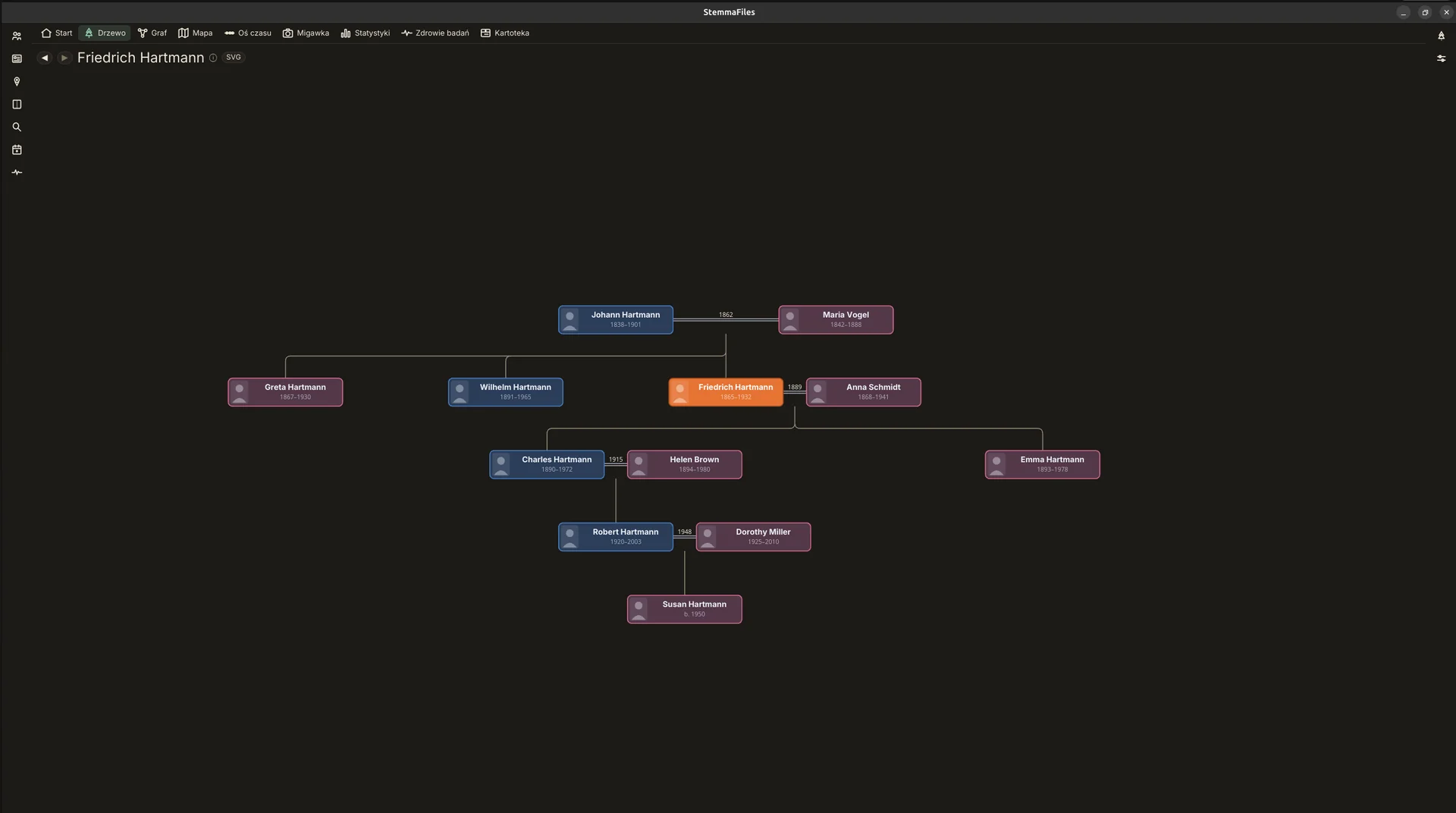
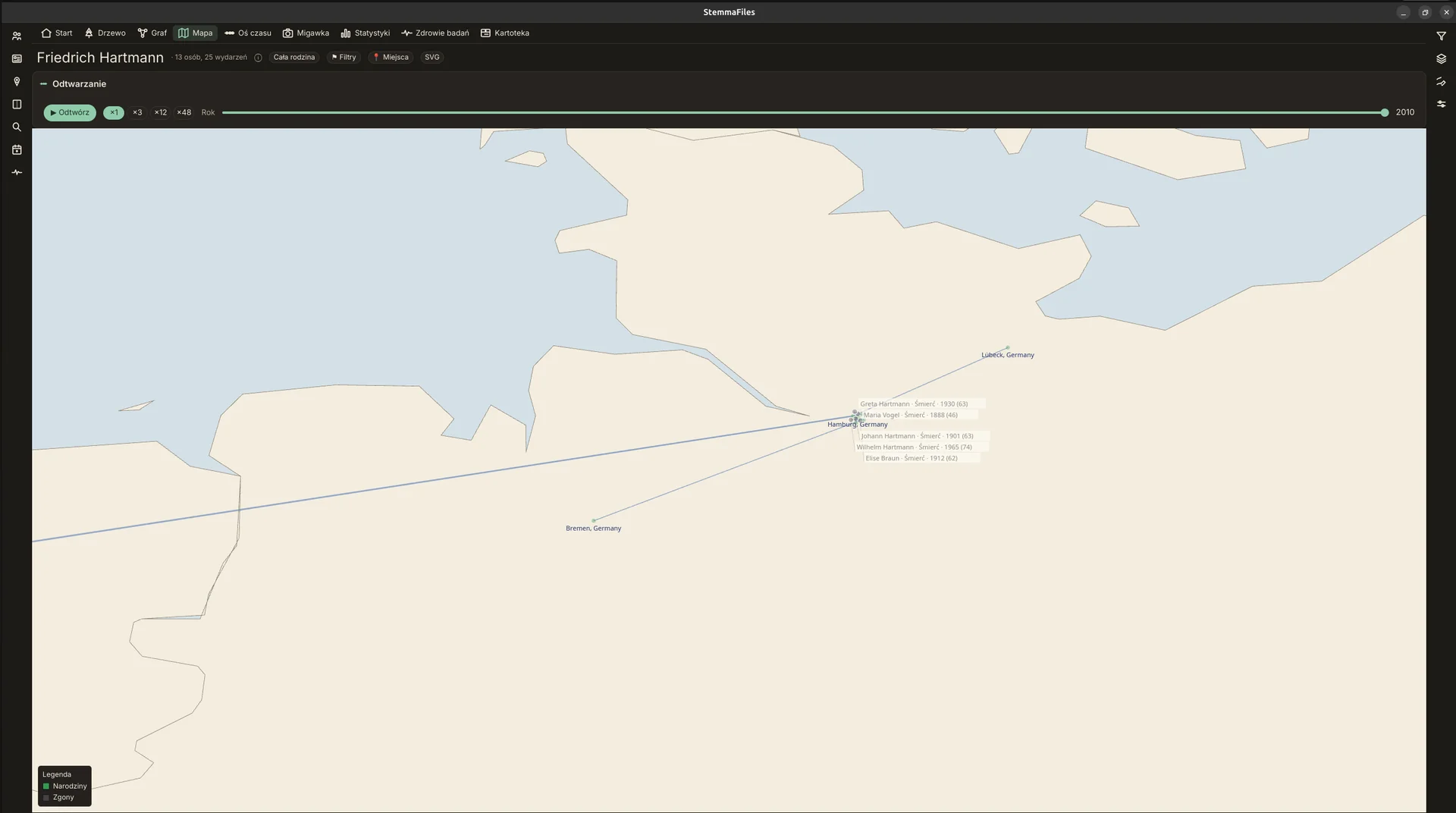
A tree with portraits, a living graph of connections, a map that traces each life, a timeline of generations — and a snapshot of any year: who was alive in, say, 1880, and in which household. All offline, and it doesn't slow down even with tens of thousands of people.
🗺️ Maps that know their history
Your villages are found without internet. Install the historical border packs and the map changes with the time slider — events from 1790 sit inside the borders of 1790. Two villages with the same name stay two separate places, not one “winner” of the name. Mark the old church, mill or manor yourself, and export any view as a crisp SVG.
🕰️ Old records' dates, understood
Church books rarely say “21 April 1782”. More often it's “Dominica III post Pascha”. Oakbough Family reads feast-day dates in Latin and Polish, understands double years like “1 Mar 1740/41”, and keeps what the scribe wrote — yet still sorts it and puts it on the map.
🧾 Proof, not guesswork
Every fact can carry its source and a confidence level, and the citation comes ready to paste, in Evidence Explained or Chicago style. And the research log remembers where you've already looked — including the searches that found nothing — so next year you don't dig through the same books twice.
🩺 Archive Health — free
A panel of its own reads the whole archive and tells you what doesn't add up: a death before a birth, a child born after a parent's death, a dated fact outside a person's lifetime, likely duplicate people and places, a link that leads nowhere, two notes claiming one identity. It also names the files it could not read, instead of quietly pretending they aren't there.
🗂️ The Registry — your archive as a table
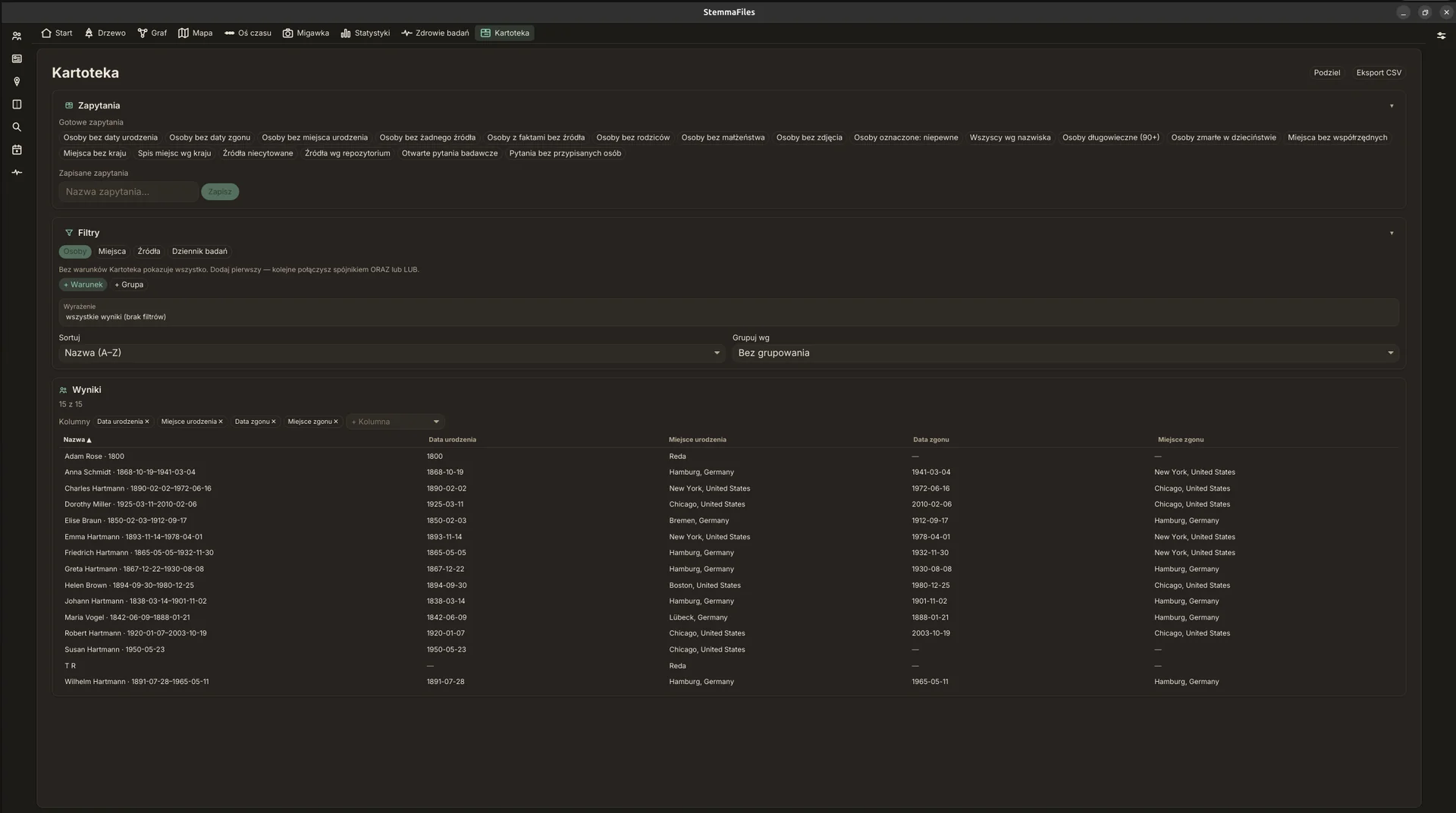
The whole archive in one searchable table: people, places, sources, research questions. Ready-made queries like “people with no birth date”, your own conditions joined with AND and OR, pick-your-own columns, CSV export. For finding the gaps before a trip to the archives, there's no better view.
👥 Godparents, witnesses, and a couple's whole life
The most interesting names in old records are often not family at all. Record who held the child at the font and who witnessed the wedding — they show up on the tree and the graph as real connections, and they survive GEDCOM round-trips. And a couple gets more than a wedding: an engagement, banns, a marriage contract, a separation, a shared census entry, or an event you name yourself.
📷 Photos, scans and faces
Attach portraits and document scans to people and sources. Tag the faces in a group photo and each person gets their own portrait crop from it — it follows them into the tree, their card and the family website.
📄 Print-ready reports
Seven kinds of PDF: a family sheet, ancestor and descendant lists, pedigree and fan charts, a full person profile. Plus a complete family book with its own name index — just the thing for the table at a reunion.
🌐 Your tree as a website
One click and your tree becomes a small private website: a clickable chart, a page for every person, your photos, living relatives kept anonymous. Send the family a ZIP — no app or account needed to look.
🔒 Private and offline
No telemetry, no account, nothing leaves your computer. People who are probably still living are hidden by default in EVERY export — GEDCOM, PDF reports, the family website, even the tree and map images — so a file you send a cousin doesn't carry your living family with it. Backups are the opposite: always complete, because their job is to rescue, not to publish.
✒️ Feels like an heirloom
Warm parchment and ink, a quiet serif for the names that matter, light and dark themes. More family chronicle than spreadsheet. The interface speaks English, Polish, German, French and Spanish.